


%20(600%20x%20315%20.jpg)
.png)

Winter Blossom at the Turning of the Year
- Renee Boje

- Dec 25, 2025
- 11 min read

Hawthorn and the Rebirth of Light
I write this on the holy cusp of midwinter, when the Earth has drawn into herself like a great dreaming animal, and the Sun is reborn from the cradle of darkness. Christmas, Yule, Winter Solstice, whatever language the heart speaks, this is the time when we gather around the invisible flame and whisper, "Return to us."
And in this season of deepest night, there is a tree who bears a secret blossom of light.
Hawthorn, the May Tree, lover of Beltane and queen of flowering hedgerows, has long been known as a companion of spring. Yet in the British Isles there is an old story of a holy Hawthorn in Glastonbury, said to have sprung from the staff of Joseph of Arimathea. This sacred tree, so the legend tells us, would flower not only in May, but again in the heart of winter, around Christmas or Epiphany. A miracle of white petals opening against the cold sky, as if the land herself were remembering the promise of return.
Whether we meet this as history, myth, or living symbol, Hawthorn becomes in this season a priestess of the threshold. She stands at the gate between darkness and dawn, between death and rebirth, between the old year and the new. Her berries still gleam red upon the branch, a heartbeat in the sleeping hedgerow. Her thorns are bare but resolute, guardianship made visible. And somewhere deep in her wood, the memory of blossom stirs.
For me, Hawthorn at midwinter is the Crone Mother of the Heart, the one who keeps watch through the longest night, who reminds us that love does not end when the world grows cold, and that hope can bloom in the most unlikely hour. She is a teacher of sacred boundaries and fierce compassion. She whispers:
"You may rest now. The light will come again. Your heart can hold this."
So we enter this Hawthorn grove at Christmas not as tourists of folklore, but as pilgrims of the heart, to learn what it means to bloom in darkness, to keep faith with the returning Sun, and to remember the ancient feminine wisdom written in thorn, berry, and star.
Hawthorn: Heart of Thorns, Heart of the Goddess

Walk the hedgerow in May and She will find you.
There, where the fields give way to wildness, a small, thorny tree stands crowned in white blossom. The air is suddenly heavy and sweet, almost indecent in its richness. Bees move in a humming halo around Her, and for a moment the world tilts , as if you have stepped not beside a tree, but to the skin of a doorway.
This is Hawthorn. May Tree. Whitethorn. Bride of the hedgerow, guardian of thresholds, and ancient ally of the heart , physical and emotional, human and holy.
As a pagan priestess, I meet Hawthorn as a She: a fierce and tender feminine presence who holds the paradox of love and boundary, blossom and thorn. In this piece, I want to walk with you through Her myth, medicine, and magic , and to introduce some of the goddesses and feminine archetypes who move through Her branches.
Hawthorn in the Green World

Botanically, Hawthorn is Crataegus spp., a small tree of the rose family, Rosaceae. Like rose, she armors herself with thorns, bears five-petaled white (sometimes pink) blossoms, and later, bright red fruits called haws.
Across Europe she is one of the most common hedge trees, woven into the very bones of the rural landscape. In Britain she was once known simply as “May” , not just because she flowers around that time, but because her boughs were the May Day decorations: the maying of medieval lovers was, quite literally, riding out to gather hawthorn blossom.
Yet for all her familiarity, Hawthorn has never been ordinary. She is one of those trees whose stories accumulate over centuries , a plant so saturated in legend that to sit beneath her, in some places, is still considered risky.
The Faery Tree & the Liminal Feminine

Hawthorn’s most enduring role in Celtic and British lore is as a faery tree , a living threshold between worlds.
In Irish and Scottish tradition, a solitary hawthorn standing alone in a field or on a mound was not just a tree but a faery dwelling. To cut down such a “lone bush” could invite illness, ruin, or even death. Even today in parts of Ireland, new roads and construction sometimes bend around a respected fairy hawthorn rather than risk offending its unseen inhabitants.
In the Scottish tale of Thomas the Rhymer, the thirteenth-century seer falls asleep by a hawthorn tree and awakens to meet the Faery Queen, who draws him into the Otherworld for seven years. The image is almost liturgical: the human poet at the roots of Hawthorn, the Faery Queen descending like a goddess of initiation at the border of worlds.
Here Hawthorn herself becomes an archetype of the liminal feminine:
She is the witch-queen at the crossroads, choosing who may pass.
She is the enchantress of altered time, where seven years slip by as easily as a dream.
She is patroness of those who walk between realities , poets, seers, healers, and hedge-witches who, like Hawthorn’s own hedgerows, mark the edge yet never wholly belong to either side.
Maiden, Mother, Crone in Blossom, Berry, Thorn

Modern herbal writers and folklorists often see Hawthorn as an embodiment of the Triple Goddess archetype , Maiden, Mother, and Crone.
In spring, Her blossom is the Maiden: fresh, white, erotic in scent, crowned in May for Beltane and new love.
In autumn, Her berries are the Mother: red as blood, nourishing heart and circulation, sustaining birds and humans through the darkening year.
In winter, Her bare thorns and bones of branch are the Crone: stripped to structure, a hedge of protection and necessary boundary.
This seasonal choreography mirrors the Triple Goddess of neopagan traditions, where Maiden, Mother, and Crone are both stages of life and phases of the moon. Hawthorn gives that cosmic pattern a vegetal body: She is the waxing, full, and waning feminine, written in wood and sap.
Goddesses of the Hawthorn
Cardea: Roman Guardian of the Threshold

In Roman tradition, we meet Cardea, a lesser-known but potent goddess of door hinges and thresholds. Ancient sources describe her as the one “whose power is to open what is shut and to shut what is open,” a keeper of boundaries and access.
Ovid tells us that Cardea’s emblem and protective tool was a branch of whitethorn , hawthorn. She used it to ward off striges, vampiric bird-witches who preyed upon children at night.
Here, Hawthorn becomes:
a talisman against malefic forces,
a guardian of the young and vulnerable,
and a symbol of sacred thresholds , doorways, hinges, the pivot points of fate.
Cardea herself is not soft; she is a priestess of the hinge, turning destiny with a flick of the wrist. Through Her, Hawthorn’s thorns are not cruelty, but holy discernment: what is allowed in, what is kept out.
Brigid: Fire, Wells, and the May Tree

In Celtic-inspired paganism, Hawthorn often appears in the orbit of Brigid (Brigit, Bríg) , goddess of poetry, smithcraft, healing, and holy fire. Brigid’s wells and healing springs in Ireland are frequently adorned with clouties , strips of cloth tied to nearby trees, often hawthorn, as offerings and petitions.
Some writers on Celtic spirituality note that hawthorn groves were associated with an earth goddess later syncretized as Saint Brigid, and that Brigid’s symbols include the Hawthorn as a sign of protection and fertility.
At Beltane (May 1), ribbons are still tied to hawthorn near springs and holy wells, prayers whispered for health, fertility, and inspiration. Hawthorn, in Brigid’s current, becomes a bridge between poetry and body, blessing and blood.
The May Queen & the Faery Queen
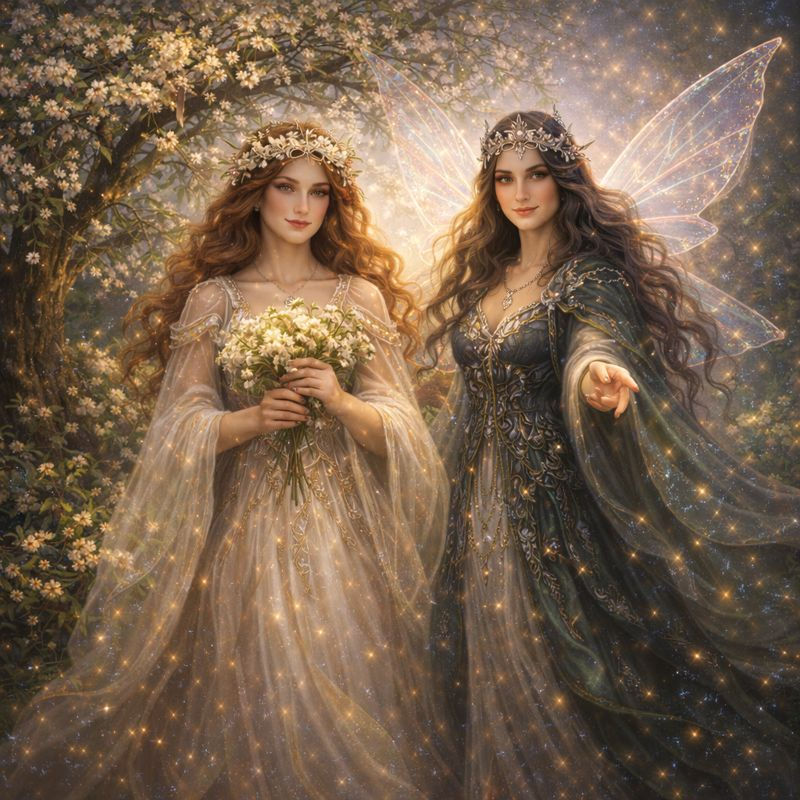
In many May Day customs, a human May Queen is crowned with flowers and rides in procession, a living embodiment of the land’s fertility. Beneath and behind this human figure is an older, wilder presence: an un-named May Queen of Hawthorn, the spirit of the blossoming hedgerow itself.
When Thomas the Rhymer meets the Faery Queen under a hawthorn tree, she feels very close to this May Queen , a liminal, erotic, sovereign feminine who can both bless and bind.
As an archetype, this Hawthorn Queen is:
Lover and land-spirit, tied to fertility and the turning of seasons.
Initiatrix, drawing the seeker across the hedge into altered states and otherworldly service.
Sovereign, reminding us that the wild does not belong to us; we belong to it.
Nemetona & the Lady of the Sacred Grove

Another goddess associated indirectly with Hawthorn is Nemetona, sometimes understood as a Celtic or Gallo-Roman goddess of the sacred grove (nemeton). Modern priestesses and writers connect her with hawthorn because of its frequent presence in ritual groves and hedge-bound sanctuaries.
Under Nemetona’s gaze, hawthorn is not just a plant but a temple wall, marking the sanctuary where rite and prayer take place.
Mary, Queen of May

As Christianity spread, much of Hawthorn’s older devotion seeped into the cult of Mary. In medieval and later Catholic tradition, May devotions to the Virgin involved crowning a statue of Mary with flowers; hawthorn was one of the traditional blossoms for this “May crown.”
Some writers even refer to Hawthorn as “Mary’s Flower of May,” a plant of both joy and mortification: she is rugged, enduring, and yet crowned in bridal white. In this Marian layer, Hawthorn carries the archetype of the sorrowful, compassionate Mother whose heart is pierced yet ever-open.
We might say that Mary, as Queen of Heaven, inherits something of the May Queen and the old earth goddesses , and Hawthorn remains at Her side, as crown and garland.
Hawthorn & the Heart: Medicine and Myth

Beyond myth, Hawthorn is one of the best-loved cardiovascular herbs in Western herbalism. Modern research and clinical practice have explored Hawthorn extracts for support in mild congestive heart failure, benign palpitations, and blood pressure modulation, generally finding them gentle and well-tolerated when used appropriately.
Herbalists frequently work with the berries, leaves, and flowers as a long-term tonic for:
circulatory support
mild anxiety or grief centered in the chest
that feeling of a “heavy” or “guarded” heart
Hawthorn appears again and again in materia medica as a nourishing, slow, and steady ally rather than a dramatic, acute remedy.
From a priestess perspective, Hawthorn’s reputation as a “heart herb” is not merely biochemical. She teaches:
Softening without collapse (blossom over thorn)
Opening with good boundaries (hedge that shelters, but does not smother)
Grief tending (berries reddening as the year declines, a quiet endurance)
To drink hawthorn tea or tincture with intention is to invite a very old, very wise heart-mother to sit beside you and say: “Beloved, we can open this, and we can survive it.”
Feminine Archetypes in Hawthorn’s Hedge
If we step back from named deities and look at Hawthorn through an archetypal lens, several feminine figures emerge:
1. The Heart-Guardian

She is the aspect of the feminine who knows how to say no: the thorned hedge that keeps out what would devour the garden. In human terms, she is healthy boundaries, discernment, the wise “gatekeeper” of intimacy and trust.
Working with Hawthorn can support inner work around:
reclaiming your right to say yes or no,
tending your own heart as sacred territory,
building relationships that honor both tenderness and autonomy.
2. The Lover & Bride of May

She is the erotic, blossoming body, unabashed in her scent and desire. This archetype delights in sensuality, in courtship, in the celebration of embodied love. She is crowned at Beltane, draped in flowers, moving through the world with the confidence of a landscape in full bloom.
Hawthorn invites us to reclaim joyful sexuality as something holy and seasonal , not separate from spirit, but arising from the living earth.
3. The Priestess of Thresholds

As fairy tree and Cardea’s bough, Hawthorn is a liminal priestess: watcher of doors, crossroads, and life transitions. She stands beside:
house doors and children’s beds (in Roman tradition),
holy wells and sacred groves (in Celtic lands),
and the invisible doors to the Otherworld.
This archetype resonates with psychopomps, midwives, death-doulas, and any of us who hold space at transitions , birth, death, grief, identity shifts, or spiritual awakenings.
4. The Crone of the Hedgerow

In winter, Hawthorn is all bone and thorn. This is the Crone aspect: uncompromising, clear-eyed, more concerned with truth than with being liked. She is the part of us that will not tolerate exploitation or disrespect, and that can see through glamours and illusions.
To sit with Hawthorn in her leafless season is to learn something about saying the hard thing, about ending what must be ended, about the way real love sometimes prunes.
Working with Hawthorn in Your Own Practice
If you feel called to build a relationship with Hawthorn, consider these gentle, grounded approaches:
1. Meeting the Tree

If you are able, visit a hawthorn in person:
Approach as you would a temple: slowly, with attention.
Offer something simple and biodegradable , a breath, a strand of hair, a song, or clean water at her roots.
Sit at a respectful distance and listen. What do you feel in your body? How does your chest respond?
Remember that in many traditions, cutting branches from a lone hawthorn , especially a known fairy tree , is taboo. When in doubt, do not cut. Let your work be devotional, not extractive.
2. Hawthorn as Plant Ally (With Care)

Teas and infusions of leaf and flower can be a gentle daily tonic for the emotional heart.
Berries can be crafted into syrups, cordials, or tinctures , traditional ways of working with Hawthorn as a nourishing heart ally.
You might combine Hawthorn with allies like rose, linden, or motherwort in ritual teas for grief, heartbreak, or gentle heart-opening ceremonies.
Plant medicine is a relationship, not consumption: ask, listen, go slowly.
3. Rituals at Beltane and May

Because Hawthorn is so deeply tied to May and Beltane, she shines in:
Handfastings & love rites: a hawthorn branch placed near (not cutting from a lone faery tree) the altar, or a symbolic representation of hawthorn in flowers and art, to bless the union with endurance and joyful passion.
Rites of erotic reclamation: inviting Hawthorn as a guide to reclaim your own sensuality, especially if you’ve been shamed or severed from it.
May Queen devotions: offering songs, dances, or prayers at dawn when Hawthorn first comes into blossom, honoring the land’s fertility and your own creative fire.
Closing: At the Hedge of the Heart

Hawthorn is not a gentle, pastel goddess. She is real countryside: mud and birdsong, birth and burials, faery abductions and children’s laughter, wedding torches and plague fears. She is a hedge , the place where a field ends and the wild begins.
In a culture that often demands we keep our hearts either completely open (and thus exploitable) or entirely armored (and thus starved), Hawthorn offers another way:
Blossom over thorn. Softness over structure. Love with boundaries.
And so, at the turning of the year - May Hawthorn keep watch at the wild edge of your heart.
May Her thorns guard what is precious. May Her blossoms remember the light for you, even in the longest night. As this year exhales into darkness and the Sun is born anew, may you rest into the knowing that love endures - even here.
Hawthorn teaches us boundaries that bless, softness rooted in strength, and a faith as old as Mother Earth Herself - that the light will always return. May we carry this wisdom forward through this time of darkness and deep shadow work, each of us a small flame in the winter night, keeping vigil for the dawn rising upon Spring’s horizon.
Written by Renee Boje, with Love & Devotion for the Sacred Hawthorn
Sources and Further Reading
=
Graves, Robert. The White Goddess: A Historical Grammar of Poetic Myth. London: Faber and Faber, 1948.
Haggith, Mandy. "Hawthorn." In contemporary essays on tree lore.
Ovid. Fasti. Classical Latin text describing Roman ritual and mythic traditions, including the figure of Cardea.
Rätsch, Christian. The Encyclopedia of Psychoactive Plants: Ethnopharmacology and Its Applications. Rochester, VT: Park Street Press, 2005.
Wood-Martin, William Gregory. Traces of the Elder Faiths of Ireland. London: Longmans, Green and Co., 1902.
Contemporary herbal monographs and research summaries on hawthorn and cardiovascular support, including Western herbal materia medica texts published in North America.


Comments