


%20(600%20x%20315%20.jpg)
.png)

Demeter: Goddess of Grain, Mother of Mysteries
- Renee Boje

- Aug 1, 2025
- 9 min read

As the Wheel of the Year turns and we approach the golden threshold of Lughnasadh, the first harvest festival of the Celtic calendar, the earth swells with abundance. This is the sacred Sabbat of grain and fruit, of ripening fields and sun-warmed offerings—a time when we gather in reverence for the fruits of our labor and the mysteries of the sacred cycles.
Those Sisters feeling called to honor Lughnasadh in our next Wheel of the Year Ceremony, please feel welcome to join us.
Lughnasadh, also known as Lammas, falls midway between Summer Solstice and Autumn Equinox. It is a fire festival, a solar rite of gratitude and sacrifice, named after the Celtic solar god Lugh. Yet beneath its solar mask, Lughnasadh holds a deeper mystery—a feminine heartbeat that pulses through the sheaves of wheat, the reddening berries, and the loaves baked in devotion. It is a time of honoring the Earth Mother in her fullness, and among the goddesses revered during this ancient feast is Demeter, the radiant bearer of grain and guardian of the sacred harvest.
And so, in devotion to Demeter, I felt called to share this writing—a remembrance of her entheogenic rites, her priestesses, and the living sacraments of fungi and barley that once opened the gates to the underworld and the stars.
Before we enter the mysteries of kykeon and the Eleusinian path, let us first meet the Goddess in her own golden light.
Demeter is the golden-bodied Mother of Wheat, the Nourisher of All, the womb of the Earth who weeps for her daughter and causes the seasons to turn. Demeter is one of the most ancient and beloved goddesses of the old world—a sovereign feminine deity of agriculture, sacred cycles, and soul initiation.
In Greece, her worship spanned from the Minoan period through the classical age, and her mysteries endured for nearly two thousand years. Her name likely stems from Da-Mater, meaning “Earth Mother”, and her roots run deep into pre-Hellenic and Anatolian earth goddess traditions. She was honored in Eleusis, Arcadia, Crete, and Sicily, and beyond.
Sacred Symbols & Correspondences of Demeter
Element | Symbolism/Details |
Titles | Earth Mother, She of the Grain, Bearer of the Golden Sheaf, Lady of the Mysteries |
Sacred Plants | Barley, wheat, poppy, mint, myrtle, corn, mugwort, fennel |
Fruits | Pomegranate, fig, apple, grape |
Sacred Flowers | Narcissus, daisy, marigold, iris |
Animals | Serpent, pig, crane, bee |
Colors | Gold, saffron, green, white |
Tools/Symbols | Torch, sheaf of wheat, sickle, cornucopia |
Associated Rites | Thesmophoria, Eleusinian Mysteries, Lughnasadh (Lammas), harvest festivals |
Day of the Week | Friday (also sacred to Venus and the feminine) |
Astrological Links | Virgo (the Virgin of the Grain), Taurus |
Myths of Demeter: Sacred Teachings in Story Form
The Abduction of PersephoneCentral to Demeter’s mythos is the story of her daughter Persephone, who is taken to the Underworld by Hades. Demeter’s grief causes the Earth to become barren, initiating the first winter. Her joy upon Persephone’s return brings spring—marking the sacred cycle of death and rebirth. This myth is the spiritual foundation of the Eleusinian Mysteries.
The Eleusinian MysteriesDemeter journeys to Eleusis in her grief and teaches humanity the secrets of grain cultivation. She chooses a royal family to entrust with her mysteries, and in their honor, the most revered spiritual rites of the ancient world are born. These rituals, held in her name, guide initiates through symbolic death and ecstatic rebirth.
Demeter and TriptolemusDemeter gifts the knowledge of agriculture to Triptolemus, a mortal youth, empowering him to teach all of humanity how to cultivate the land. This myth marks Demeter as not only a goddess of nourishment, but of divine transmission, offering sacred skills to uplift humanity.
From these roots of myth and symbol, the path of the priestess and the sacred rites of kykeon unfold. Let us now journey into the temple of memory, where mushrooms bloom like stars in the fields of Eleusis...

Demeter’s Kykeon: A Sacred Mushroom Rite of the Harvest Goddess
In the ancient world, long before the rise of patriarchal religions and their suppression of the feminine mysteries, there walked among us the priestesses of Demeter—the grain-bearing Mother, the radiant giver of life, and the sovereign of the sacred cycles. Her name echoed across the hills of Greece, invoked in whispered prayers among golden fields and thunderous chants in subterranean sanctuaries. She was the harvest and the hunger, the reaper and the sower, and at the heart of her worship stood an entheogenic sacrament: a divine elixir that opened the gates of life, death, and renewal.
Demeter’s mysteries did not dwell in abstraction. They were embodied rites, ecstasies of the Earth, rooted in the Feminine Mysteries of the Goddess Demeter. Her sacred celebrations unfolded during the Dionysian period—a time of ecstatic revelry, ritual theatre, and communion with the wild forces of nature. While Dionysus inspired the frenzied liberation of the spirit, Demeter grounded the soul in the fertility of the land. Together, their worship revealed the sacred marriage of vine and grain, mushroom and nectar, frenzy and harvest.
The rites of Demeter reached their holy climax in the Eleusinian Mysteries, held each year in the shadow of Mount Hymettus and the plains of Eleusis. These ceremonies—open to women and men alike—honored the descent of Persephone into the underworld and her return to the arms of her mother, a myth that mirrors the sacred spiral of the seasons and the rebirth of the soul. But within the myth lies a deeper current: an encoded teaching of divine communion through entheogenic sacrament.

The Priestesses of Demeter: Keepers of the Sacred Mysteries
The women who served the temple of Demeter were more than mere attendants—they were oracles, healers, and guides of soul initiation. Daughters of Gaia and midwives of the unseen, these priestesses held the keys to the initiatory gates, guarding the secrets of the kykeon and leading seekers through the labyrinth of transformation. Cloaked in white or saffron robes, crowned with myrtle or ears of wheat, they invoked the goddess with song, dance, and the brewing of sacred potions.
They lived cyclically, attuned to the rhythms of the moon and soil. On Demeter’s feast days—especially during Thesmophoria, a women’s-only festival—they enacted ancient rites of fertility, death, and rebirth. Offerings were made in the form of cakes shaped like mushrooms, serpents, and vulvas. In some regions, it is believed these cakes were not mere symbol—they were vehicles for altered consciousness, infused with psychoactive ingredients such as sacred fungi.
These rites were ecstatic and often nocturnal. Women would descend into caves or sacred groves, fast and purify, then drink the kykeon. In this liminal state, they journeyed with Persephone, walking the spiral path of descent into the Earth Mother’s womb and emerging reborn. The use of mushrooms—particularly Amanita muscaria or ergot-infected barley—was not merely speculative; it was part of a living technology of the soul, now veiled in silence and time.
And so we remember...

The Sacred Rites of the Eleusinian Mysteries: The Divine Communion of Fungi and Ecstatic Revelation
Through the mists of time, the voices of the ancient initiates whisper to us still. Barefoot upon sacred ground, they walked the path to Eleusis, their souls alight with longing, their hearts opened by mystery. There, beneath the watchful gaze of Demeter and Persephone, the Divine Feminine was honored in her many forms—as maiden, mother, and crone; as seed, blossom, and fruit.
In the sacred rites of the Eleusinian Mysteries, the veil was lifted. The women and men who gathered were not merely spectators—they were participants in an ancient alchemy of transformation. Guided by priestesses and cloaked in secrecy, they partook of a sacred sacrament known only as the kykeon—a brew whose psychoactive nature has long been speculated to contain entheogenic fungi, unlocking visionary states and ecstatic union with the Divine.
The frenzied revels of Dionysus echoed these rites, where wild abandon gave way to transcendence, and the body became a vessel of divine channeling. And at Delphi, the Oracle—often a woman—entered trance through inhalation of sacred fumes rising from the Earth, communing with the gods to offer guidance that shaped the fate of empires.
Across these holy traditions, one truth rings clear: the divine sacraments of the Earth, and especially the sacred mushrooms, were not feared—they were revered. They opened portals to gnosis, to remembrance, to direct communion with the Goddess Herself.
These ancient rites were not primitive—they were sophisticated technologies of the soul, encoded with the wisdom of thousands of years. They were ceremonies of deep feminine power, offering not salvation through dogma, but revelation through direct experience. And it is through these rites that many awakened to the sacred cycles of death and rebirth, descent and return—initiated into the mysteries that live within every woman’s body, and every fertile field of Gaia.
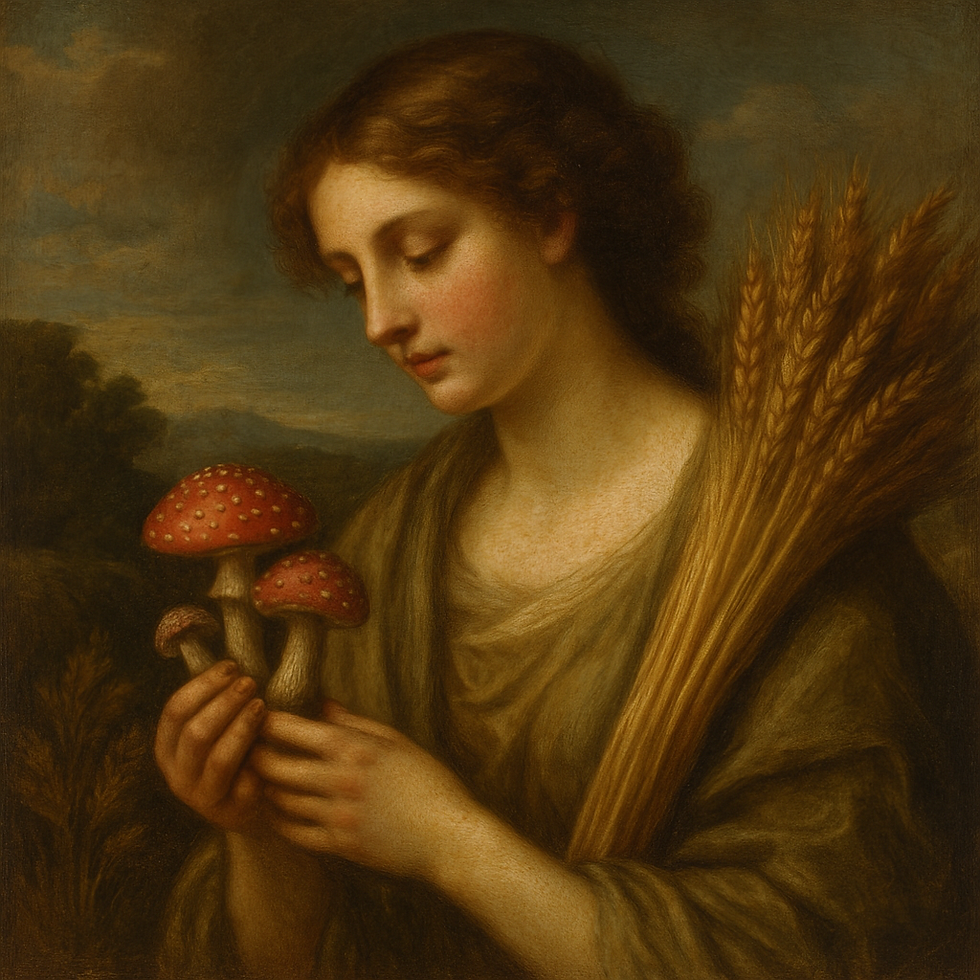
The Entheogenic Spirit Medicines of Greece
It is known among scholars and mystics alike that the initiates of the Eleusinian Mysteries and other ancient Greek spiritual traditions partook in sacred plant spirit medicines to access the numinous. The veil between the mortal and divine was lifted by the sacramental use of entheogens—likely mushrooms and other fungi—which invoked states of rapture, revelation, and deep communion with the Divine.
One such entheogen, ergot (Claviceps purpurea), a potent fungal growth found on grain, is believed to have played a role in these divine rites. This mystical fungus contains LSA, a precursor to the famed psychedelic LSD, known for its ability to dissolve the barriers between self and spirit, time and eternity. Through ritual ingestion, the initiates of Demeter and Persephone may have walked the spiral path of death and rebirth, encountering the shadowed depths of Hades before emerging reborn in the embrace of the Mother Goddess.

The Kykeon: The Sacred Drink of Transformation
The Eleusinian Mysteries, among the most revered spiritual rites of ancient Greece, centered around the myth of Persephone’s descent into the underworld and her triumphant return—a metaphor for the cycles of life, death, and rebirth. At the heart of these mysteries was the kykeon, a sacred drink imbued with divine power. Though its exact composition remains hidden beneath the silence of the ages, many scholars now believe that the kykeon contained visionary fungi, unlocking the gateway to divine revelation.
Initiates who partook of the Lesser Eleusinian Mysteries were instructed to gather a wild “bulbous plant” at Agrai as part of their sacred preparation. Some depictions of urns from these ceremonies appear to brim with mushrooms, leading to speculation that the term “bulbous plant” was, in truth, a reference to the sacred fungi. The Greeks, believing mushrooms to be plants of mysterious origins, described their gathering in terms reflective of their limited botanical understanding but deep spiritual reverence.

Persephone, Demeter, and the Sacred Amanita Muscaria
Persephone, the Queen of the Underworld, is the eternal maiden who descends into the darkness, only to rise again in the embrace of her mother, Demeter, Goddess of Grain and Harvest. Their sacred dance mirrors the changing of the seasons, the endless cycle of life, death, and renewal. Within this myth, hidden within the sacred rites of Eleusis, lies the key to an ancient and entheogenic wisdom—the presence of the Amanita muscaria mushroom.
Amanita muscaria, with its vibrant red cap and white spots, has long been associated with divine ecstasy, death, and rebirth. It is said to emerge from beneath trees in the autumn, the season of Persephone’s descent into the Underworld. Like the goddess herself, the mushroom is linked to both worlds—the earthly and the chthonic, the above and the below. The sacred knowledge of Amanita muscaria may have been part of the Eleusinian rites, hidden within the kykeon, allowing initiates to experience the liminal space where Persephone walks, guided by the wisdom of the divine mycelial web.
Demeter, the great nourishing Mother, is the force of creation that governs the fertility of the land, and it is through the consumption of the sacred mushroom that the initiates may have connected with her divine presence. Amanita muscaria, often found growing in symbiosis with sacred trees, represents the hidden knowledge of nature, the wisdom of the earth itself. Just as Demeter searches for her lost daughter, so too do the initiates seek the hidden mysteries of life, consuming the divine fungus to access the truths of existence.
-Written by Renee Boje with Love & Devotion for the Goddesses Demeter & Persephone & the Sacrament of Mushrooms & Ergot
Please feel welcome to visit my Patreon Page. If you resonate with this blog entry & are interested in diving deeper in exploring the history & magic of plant spirit medicines, please visit my crowdfundr website, where your can learn more about the book I am currently working on, Entheogens & the Goddess, and discover the ways in which you can support the birth of this passion project.
References:
Agosti, Aldo, and Carl A. P. Ruck. The Road to Eleusis: Unveiling the Secret of the Mysteries. 2nd ed. Berkeley: North Atlantic Books, 2008.
Hamilton, Edith. Mythology: Timeless Tales of Gods and Heroes. New York: Grand Central Publishing, 2011.
Hofmann, Albert, Richard Evans Schultes, and Christian Rätsch. Plants of the Gods: Their Sacred, Healing, and Hallucinogenic Powers. 3rd ed. Rochester, VT: Healing Arts Press, 2018.
Kingsley, Peter. In the Dark Places of Wisdom. Inverness, CA: Golden Sufi Center, 1999.
Kerenyi, Karl. Eleusis: Archetypal Image of Mother and Daughter. Translated by Ralph Manheim. Princeton: Princeton University Press, 1991.
Muraresku, Brian C. The Immortality Key: The Secret History of the Religion with No Name. New York: St. Martin’s Press, 2020.
Ratsch, Christian. The Encyclopedia of Psychoactive Plants: Ethnopharmacology and Its Applications. Translated by John R. Baker. Rochester, VT: Park Street Press, 2005.
Ruck, Carl A. P., Blaise Daniel Staples, Clark Heinrich, and Mark Alwin Hoffman. Entheogens, Myth, and Human Consciousness. Berkeley: Ronin Publishing, 2012.
Wasson, R. Gordon. Soma: Divine Mushroom of Immortality. New York: Harcourt Brace Jovanovich, 1968.
Wasson, R. Gordon, Albert Hofmann, and Carl A. P. Ruck. The Road to Eleusis: Unveiling the Secret of the Mysteries. New York: Harcourt Brace Jovanovich, 1978.


Comments